



The idea is to integrate the invisible and intrinsic characteristics of oils with their visible characteristics, while showing that they can flow independently of potential challenges. All oil industry motion aligns in one shared direction: forward, toward progress. By JISA.
Several colors and only one name: petroleum. When we compare petroleum/oil to water, petroleum reveals far greater complexity. While distillate water has only one molecule, petroleum consists of millions. It is therefore natural to understand that oils possess different properties, and that these properties influence their value.
It’s not so simple, we don’t drink petroleum, we don’t use as received. Several steps happen between the oil trapped in the rocks and your tapware or kerosene. The complexity of oil nature needs to be simplified, facilitating not only overall understanding, but also making it easier to integrate processes and industries. Let’s see how!
API Gravity
One way to differentiate oils is by API gravity. It could be just the specific gravity, but a few more numbers, mathematical operations and now you can have the API gravity calculated using the equation below:
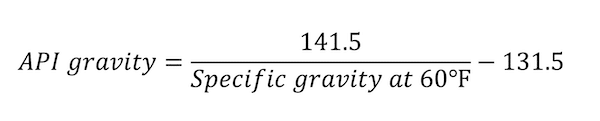
If someone says their oil has an API gravity of 10°, you already know it is a heavy, dark oil. If the number is high, it indicates a lighter oil—often yellow or orange (sometimes humorously described in Brazil as “the color of a donkey when it runs away”; choose the appropriate color reference).
You might now ask yourself: so what? Does color really convey meaningful information? Is specific gravity alone enough to infer other properties? The answer is yes.
Oil Scale
If you see a dark black oil, it likely contains asphaltenes. If you see a heterogeneous yellow oil, it is probably a light oil with some paraffin precipitating and with near zero asphaltenes. Are you following? Different colors, different compounds, different… prices!
When petroleum is heated in a distillation column, it can be separated into several fractions. Below, you can see the fractions listed from lighter to heavier:
- Petroleum Gas
- Petrol
- Naptha
- Kerosene
- Diesel
- Lubricating oil
- Fuel oil
- Bitumen (contain asphaltenes)
Each of these fractions is used for different purposes. Light fractions such as gas and petrol are highly flammable and are mainly used as domestic fuel and motor fuel in vehicles. Naphtha is an important raw material in the petrochemical industry for making plastics, chemicals, and synthetic fibers. Middle fractions like kerosene and diesel are used as aviation fuel and fuel for buses, trucks, and generators. Heavier fractions such as lubricating oil are used to reduce friction in machines. The heaviest fraction, bitumen, is used in road construction and roofing. The price of the fractions follows the law of supply and demand. And the lighter fractions generally have higher demand.
Oils with a higher percentage of light fractions (lower density) are classified as light oils and oils containing high percentage of bitumen (higher density) are classified as heavy oils. Below you can see the classification by the U.S. Energy Information Administration:
- “Light crudes generally exceed 38 degrees API.”
- “Intermediate crudes fall in the range of 22 degrees to 38 degrees API gravity.”
- “Heavy crudes are commonly labeled as all crudes with an API gravity of 22 degrees or below.”
Okay, now you understand that just by looking at the oil, you can infer some of its characteristics. By measuring its specific gravity, you can classify the oil and get an idea of whether it is expensive or cheap.
Black Gold Distribution
In general, when operators find a new oil reserve, they will be happier if it is a lighter or intermediate crude oil. This considering that the reserves being compared have the same estimated oil volume.
You could say, it doesn’t matter! The more oil, the better. A couple years ago I could say: it’s not true at all! Depending on where the reserve is located and the oil properties, the oil could not even be extracted. We didn’t have the technology.
Now we are getting deeper! Extracting extra-heavy oils! Finding new products and technologies to facilitate transport. Today we can say: the more oil, the best – and If it’s light, even better!
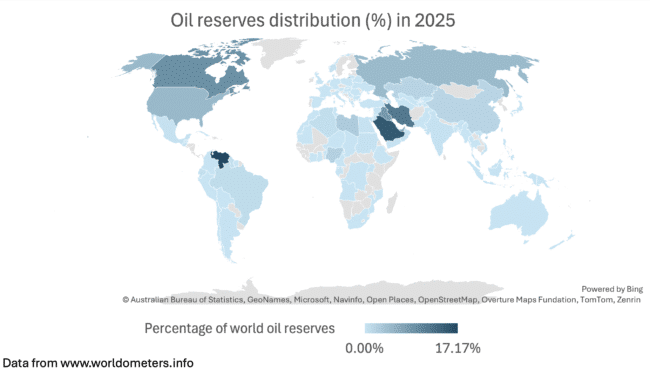
Below you can see the map of oil reserve distribution. The darker the more oil barrels. Middle East holds over half of the world’s proven reserves. Canada maintains 9.2%, mostly from sand oils, which are more costly to produce. United States has 4.7%, being the majority light oils. And you can think about the Country in evidence this last days, Venezuela. It has the largest proven oil reserve share in the world, 17.2%. The oil from there is heavy, but the current technology allows extraction and processing of these resources.
Power by raw materials
Summarizing, petroleum fractions are the current base of our modern life. They provide heating, fuel for cars and trucks, synthetic shoes and clothing, kitchen utensils, machinery, gardening equipment, and even chewing gum.
If a country possesses the raw material, it is halfway to producing cheaper derivatives and selling them to the world. If a country does not have it, it must either purchase petroleum or invest in other countries to extract it.
Sometimes a plant receives one type of oil, but the refining process requires blending it with another type of oil to achieve optimal efficiency. This can occur with both light and heavy crude oils. Having the right raw material increases the value of the final products.
Beyond its chemical and physical properties, petroleum underpins the geopolitical and economic power of nations. Countries with abundant reserves can produce derivatives, supply global markets, and generate significant economic influence, while those without must import or invest internationally. Technological advances now allow extraction and processing of previously “difficult” oils, expanding opportunities and reshaping the value of reserves worldwide. Whether light or heavy, petroleum fractions feed different industries. By connecting natural characteristics to industrial use and global distribution, we see clearly how the different oil types moves the world.
Ah! And the most important, ICP has chemicals that helps to produce and transport the oils ranging from condensate to extra-heavy.